
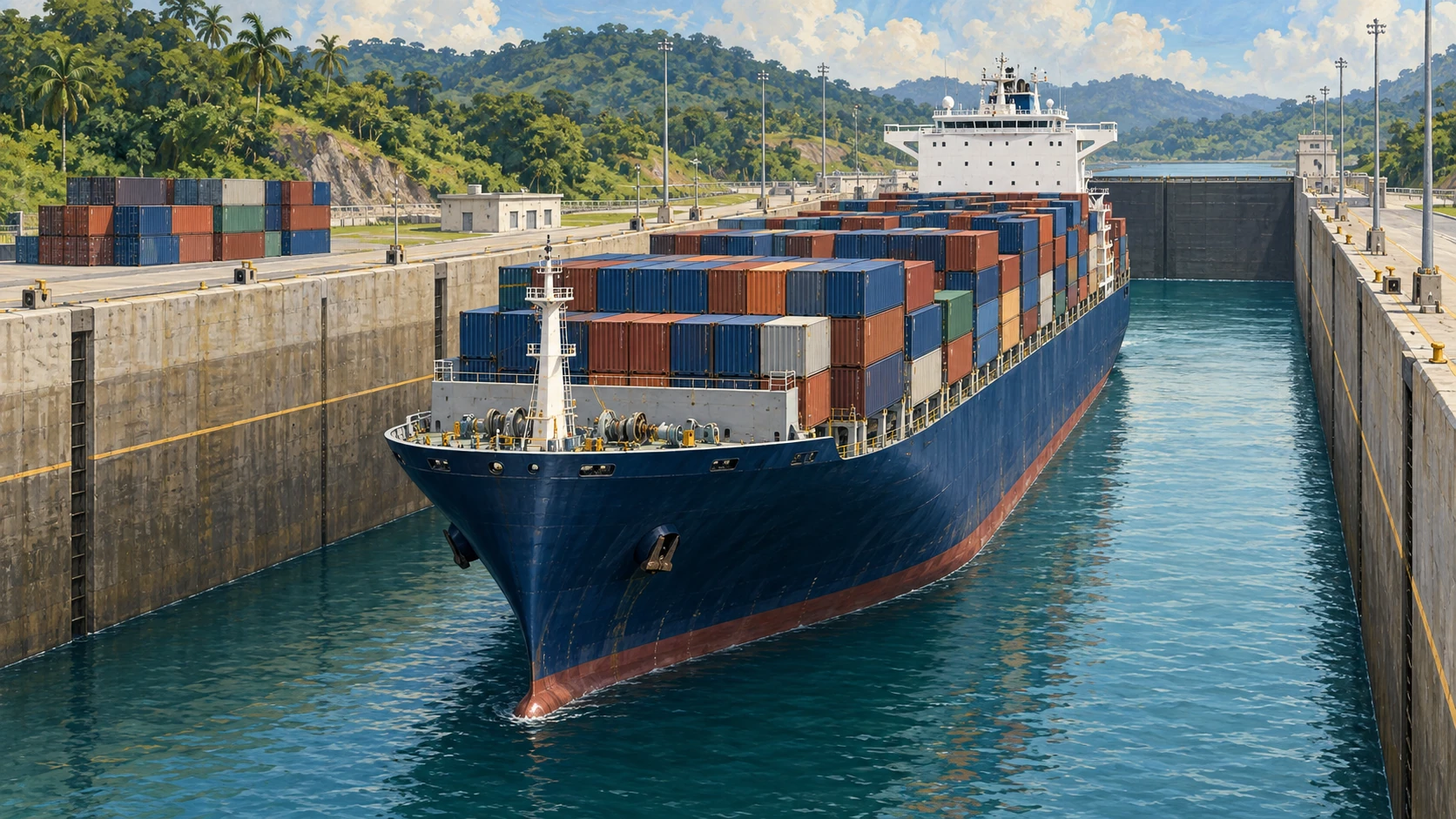
The Panama Canal Authority’s (ACP) latest Neopanamax draft restriction took effect on 15 August 2026. Under Advisory to Shipping A-22-2026, the maximum authorised draft is now 14.78 metres (48.5 feet) in Tropical Fresh Water (TFW), reduced from 14.94 metres (49.0 feet) previously. The ACP says the measure forms part of its water-management strategy under current hydrological conditions and potential El Niño development in the Canal watershed.
This is a verified operational limit, not a reported cargo casualty. Its cargo-claims significance lies in the decisions it forces before arrival: reducing a parcel, changing the loading sequence, leaving cargo ashore, altering bunkers or ballast, or revising a stow plan. Each can later become a dispute over quantity, delay, cargo allocation, freight, demurrage or the condition of cargo retained at the load port.
The effective limit is expressed in TFW, so actual departure planning should not rely on a nominal salt-water draft alone. Masters, operators and terminal planners need to reconcile the vessel’s loading computer, local density, trim and stability limits, bunker and ballast quantities, and the approved transit condition. Chartering and cargo teams should translate the restriction into a documented parcel-level instruction before completion of loading, rather than treating it as an operational adjustment after bills of lading, cargo manifests or stowage records have been finalised.
**Why this matters for claims and loss prevention:** A late reduction in cargo is easier to defend when records show precisely why it occurred, who instructed it, what was removed or retained, and how the final figures were established. The practical evidence pack should include the applicable ACP advisory, transit booking and communications, loading-computer outputs for the final condition, density information, draft-survey or shore-scale records as applicable, bunker and ballast records, cargo-tally and terminal exception records, revised stow plans/BAPLIE data, and any bill-of-lading or mate’s-receipt qualifications. Time-stamped photographs and signed survey attendance records are particularly useful where a cutback leaves cargo on the quay or requires restowage.
This is also a contract-management issue. Parties should check whether the charterparty allocates the cost and consequences of draft restrictions, cargo short-shipment, delay and alternative routing. No conclusion on liability follows from the ACP notice itself; liability will depend on the contract, instructions, vessel condition and contemporaneous evidence. ACP has said it will continue monitoring lake levels and hydrological projections, so voyage plans should retain a controlled record of the limit verified for the particular transit date.
Credit: TWS Brasil Insight.
Technology supported research and drafting. TWS retains editorial responsibility for the published content and cited sources.
Need operational support?