Commercial-vessel traffic at the Bab el-Mandeb Strait rebounded on 27 July after falling to a monthly low the previous day, while movements through the Strait of Hormuz remained subdued. The change is operationally significant because it indicates that voyage decisions continue to be revised rapidly across two linked Middle East chokepoints rather than following a stable reopening pattern.
Reuters, citing Kpler tracking data, reported that 11 commodity vessels transited Bab el-Mandeb on Sunday, 26 July—the lowest number in months—after attacks on Saudi oil facilities along the Red Sea coast. On Monday, 27 July, the number rose to 28 vessels, including four oil tankers entering the Red Sea, the highest daily total in four days. Reuters attributed the improvement in part to market optimism over a possible easing of the US-Iran conflict. Yet commercial traffic through Hormuz remained low; reporting based on Kpler data said daily commercial crossings there had remained in single digits from 24 to 26 July.
These are verified traffic observations, not confirmation that normal navigation conditions have returned. Vessel counts can be affected by security assessments, port and cargo readiness, convoy or routing decisions, insurance constraints, AIS practices and the timing of ships waiting outside risk areas. A short-lived increase in Bab el-Mandeb transits therefore should not be read as evidence that the Red Sea/Suez route is broadly normalized, particularly while Hormuz traffic remains constrained.
For owners and operators, the immediate issue is the interaction between routing, ship availability and safety management. Delayed Hormuz passages can disrupt loading windows and tanker positioning, while hesitation at Bab el-Mandeb can add uncertainty to Red Sea, Suez and Cape-routing decisions. Charterers should keep voyage orders, alternative-route assumptions, bunker plans and contractual notices under close review rather than relying on a single day’s traffic data. Cargo interests should expect volatile estimated times of arrival and possible knock-on effects on equipment cycles and inventory planning.
Why this matters: This episode reinforces that traffic recovery in a conflict-affected corridor is not necessarily operational recovery. Masters and shore teams should retain route-specific risk assessments, timely reporting arrangements, emergency communications checks and documented decision-making. P&I and claims teams may also need contemporaneous records of security advice received, route orders, delay causes, crew-welfare measures and mitigation steps if a deviation, detention, cargo delay or security-related claim later arises.
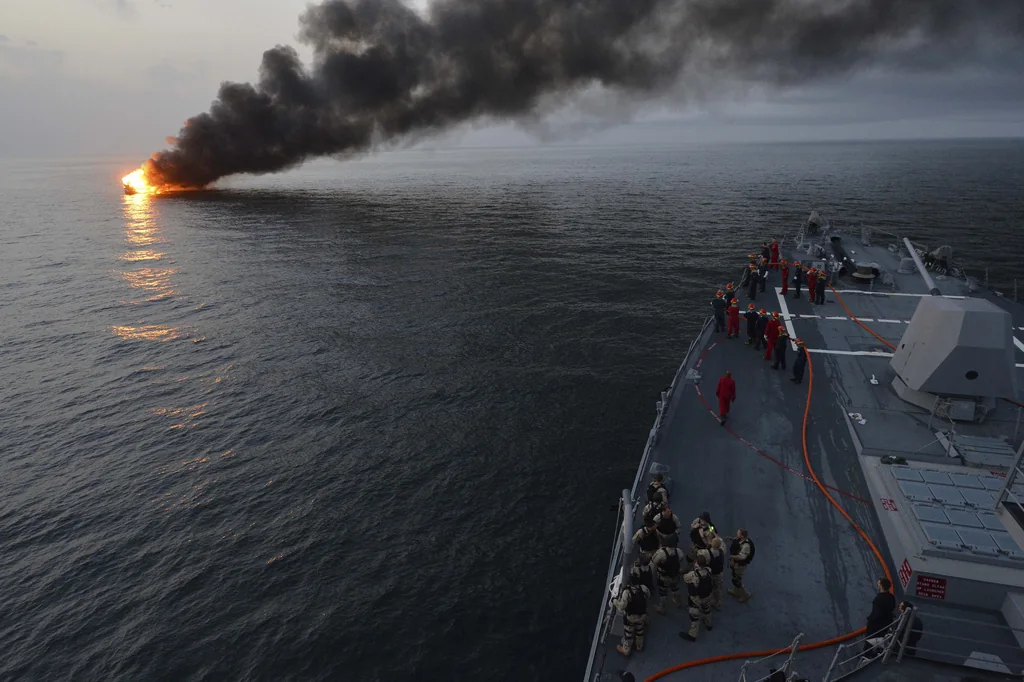
Credit: MC3 Carla Ocampo / Wikimedia Commons. Public domain. Open media source ↗
Technology supported research and drafting. TWS retains editorial responsibility for the published content and cited sources.
Need operational support?