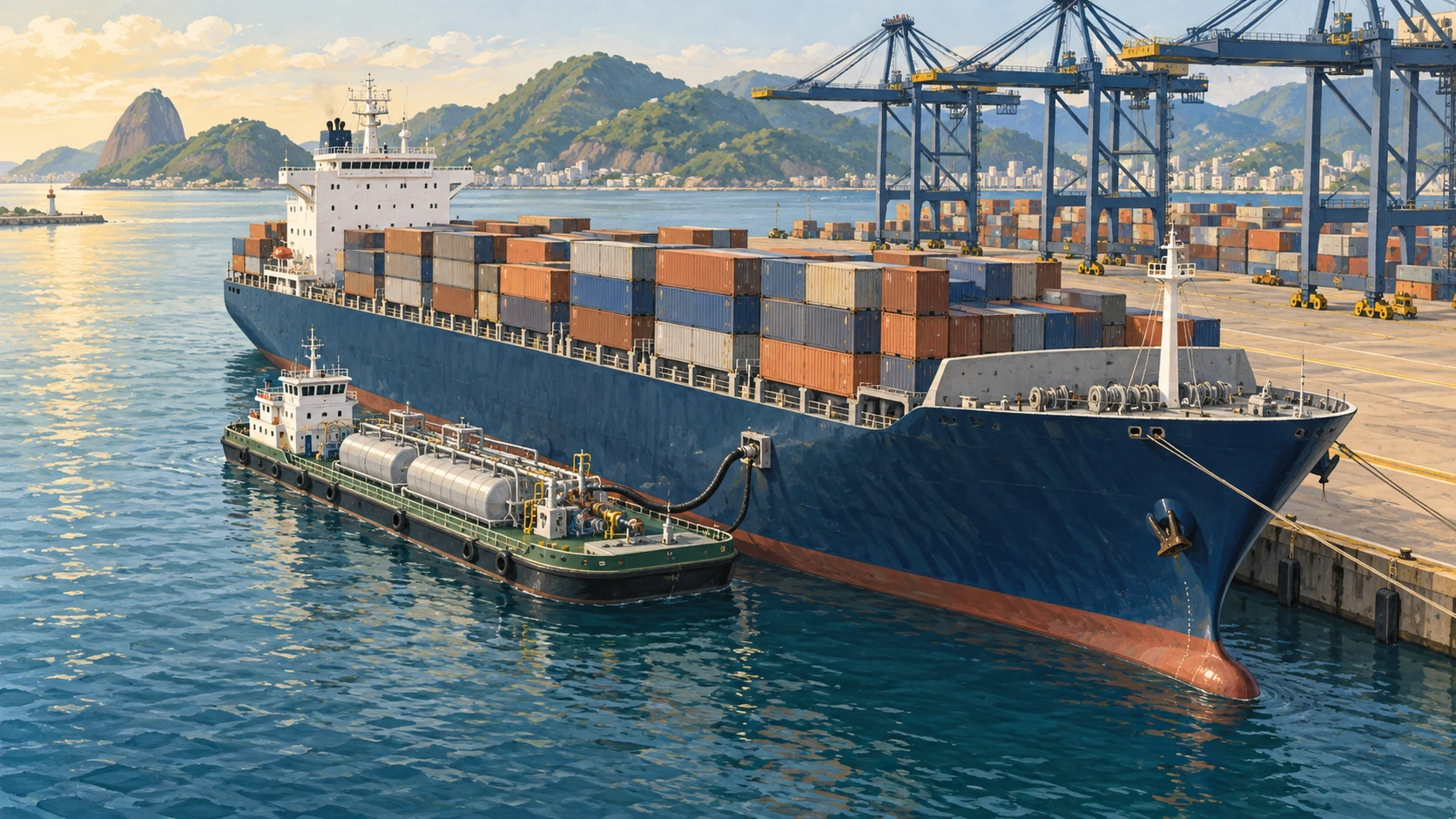
Verified development. CMA CGM, Copersucar, Bunker One, Santos Brasil, AGEO Terminais and Everllence completed a bioethanol bunkering operation for the 13,000-TEU CMA CGM IRON at the Port of Santos on 12 July 2026. The companies describe it as Brazil’s first bioethanol bunkering of a deep-sea containership. Reuters independently reported that 650,000 litres of anhydrous ethanol were supplied. The vessel is the first in a 12-ship series fitted with a tri-fuel Everllence-B&W G95ME-C10.5-LGIM engine certified to use conventional fuel, methanol or bioethanol.
The significance is wider than one bunker stem. The operation combined a Brazilian biofuel supplier, dedicated storage infrastructure at Santos and delivery by specialised barge. It therefore tested the ship-port interface required to make a liquid alternative fuel available to an ocean-going vessel without changing its liner-service role. Brazil’s Ministry of Ports and Airports published a decarbonisation study on the same date that identifies low-carbon fuels, clean technologies and energy efficiency as areas for future action across Brazilian ports and waterborne transport.
What remains unproven. This was a single operational deployment, not evidence that bioethanol is yet available at scale for international shipping or that it will provide a uniform emissions outcome. Neither the companies’ announcement nor the independent report reviewed for this briefing published a verified well-to-wake greenhouse-gas result for this specific stem. Any claimed climate benefit will depend on feedstock, land-use and production-chain evidence, transport emissions, fuel quality and the accounting method accepted in the relevant trading regime. For EU calls, FuelEU Maritime assesses the yearly greenhouse-gas intensity of onboard energy on a full well-to-wake basis, including carbon dioxide, methane and nitrous oxide.
Why this matters. Shipowners and charterers considering ethanol-capable tonnage should treat Santos as a practical supply-chain precedent rather than a fuel-price or compliance conclusion. Before fixing fuel assumptions into a charterparty, voyage estimate or emissions allocation, parties should establish the fuel specification; custody-transfer and sampling protocol; sustainability and chain-of-custody documentation; calorific-value and consumption implications; engine-maker operating limits; barge and terminal responsibilities; and allocation of off-specification, delay and emissions-reporting risk. For cargo interests, insurers and P&I interests, the key visibility question is whether the bunker delivery record, certificates, samples and voyage-consumption data can be retained in a traceable file suitable for a later claim, audit or regulatory verification. Repeat operations with independently auditable lifecycle documentation will determine whether this becomes a commercially bankable Santos capability.
Credit: TWS Brasil Insight.
Technology supported research and drafting. TWS retains editorial responsibility for the published content and cited sources.
Need operational support?